
This article was translated from its original French version with the help of AI. Read the original in French. Its images and slides remain in French.
In this publication
With five people, we did the work of five. With fifty, we do the work of thirty. If your company has grown, you know the math: the bigger it gets, the more time its people spend coordinating, answering to one another and complying with requirements.
AI enters this picture with a promise of productivity. For an individual, that promise often holds: a memo gets written faster, meeting minutes are summarized in seconds. For the company as a whole, it holds far less often. In 2025, a team at MIT reviewed more than 300 generative AI projects: consumer tools such as ChatGPT or Copilot mainly improve individual productivity, rarely the company’s results. And large companies, which launch the most pilots, are also the ones that roll out the fewest across the organization.
Our reading rests on one distinction. AI speeds up the work each person does alone. In a large organization, a growing share of time goes into work between people: coordinating, passing information along, securing approvals. As long as that share does not fall, the individual gains get diluted along the way. For AI to pay off, companies therefore need to simplify themselves and rethink the size and autonomy of their teams.
Coordination grows faster than the company
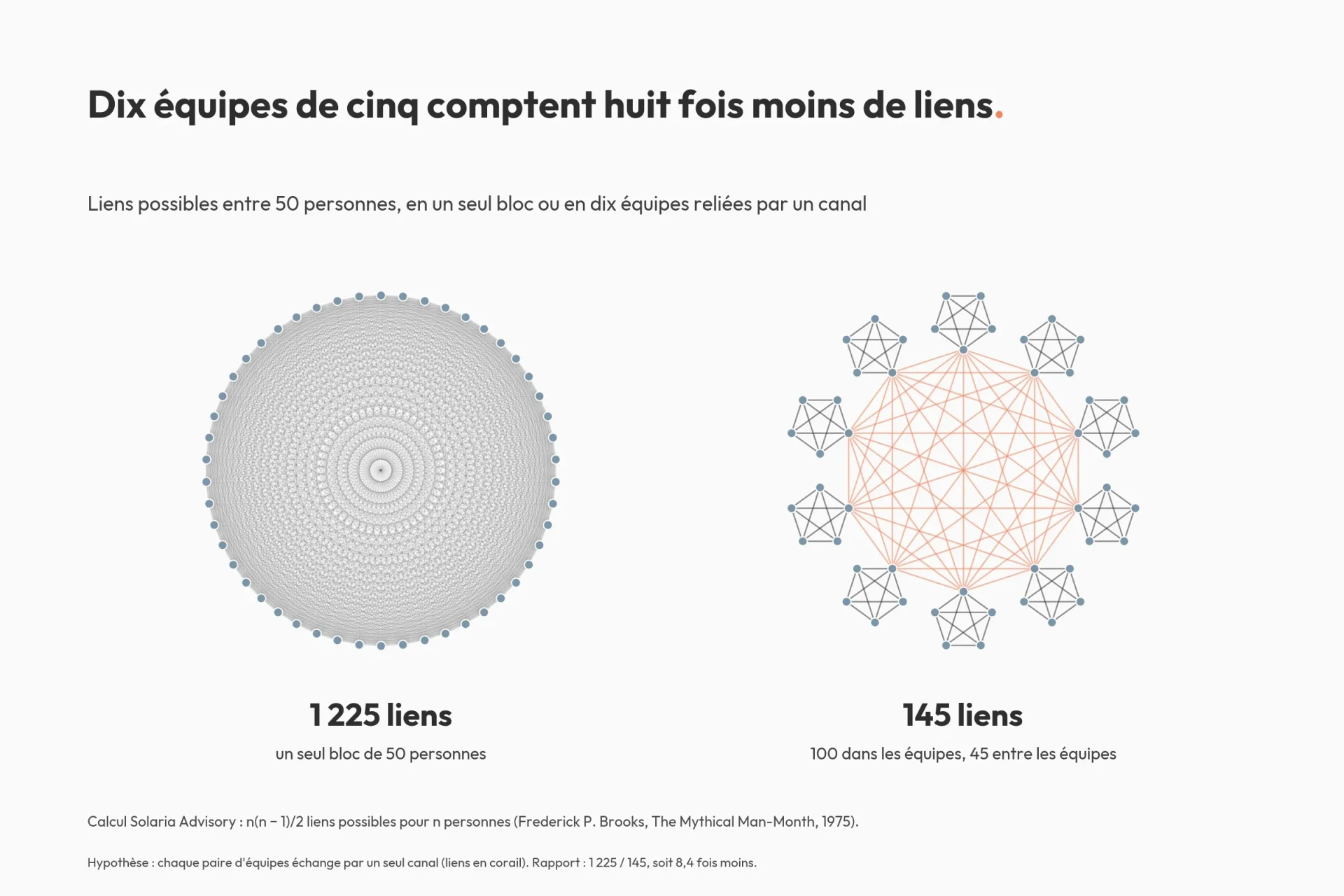
A team of five has ten possible relationships. A team of fifty has 1,225: the number of connections grows roughly with the square of the headcount. Obviously, no one maintains 1,225 relationships. So the organization adds layers, committees, reports and approval processes to keep information flowing. Each was added for a good reason, and we often find good reasons to add our own little twist, one small extra step just to make sure that… we’ve all done it. Simplifying things, though, is another matter entirely.
BCG measured this as early as 2014: over sixty years, the requirements companies must meet increased sixfold, and the complications they created to meet them increased thirty-fivefold. Bain & Company offered a concrete illustration. Reconstructing how teams at a large company spent their time, the firm found that 300,000 hours a year went into supporting a single weekly meeting, that of the executive committee. The committee itself accounted for only 7,000; the rest went into the cascade of meetings it triggered at lower levels. In France, that would mean employing 182 people for a full year solely to prepare for this weekly meeting. Not bad.
These extra complications act as a tax. Worse, it is often the organization’s best people who pay it. A share of their day, often a growing one, goes into keeping the wheels turning: following up, consolidating information, preparing the meeting that prepares the committee meeting. They are the only ones who know how the pieces fit together, and their dedication has a perverse effect: as long as they keep making up for the error, it never gets reported anywhere, and no one fixes its cause.
AI is mainly used to speed up the share of work that shrinks as organizations grow: production
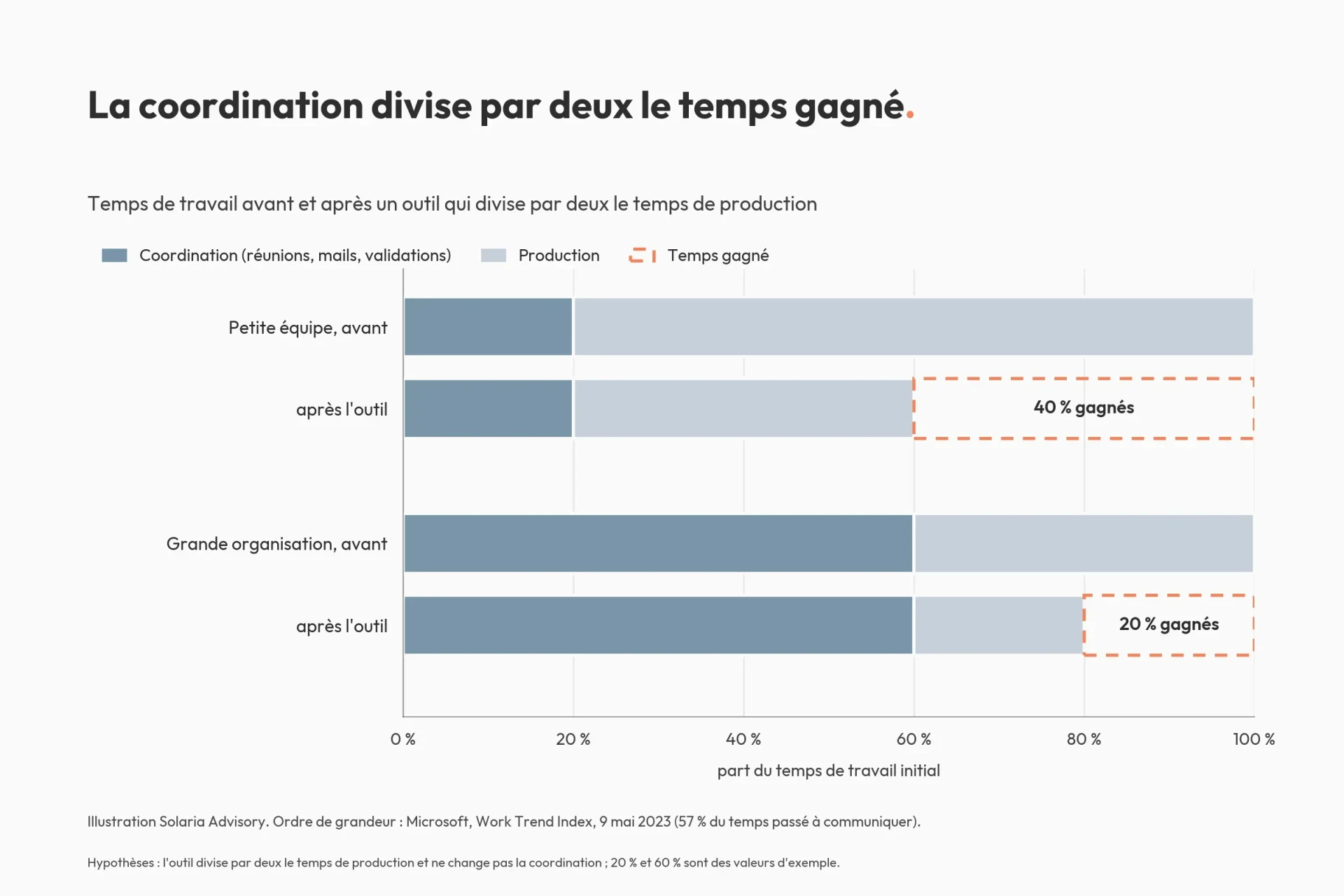
Let’s compare two situations. In a team of five, coordination takes up little time. In a large organization, it can take up most of it. In 2023, Microsoft found that the average Microsoft 365 user spent 57% of their time communicating (meetings, email, messaging) and 43% producing (documents, spreadsheets, presentations). Let’s use 20% for coordination in the small team and 60% in the large organization.
Give both the same tool, one that halves production time, and leave coordination as it is. The team of five saves 40% of its time. The organization where coordination takes up 60% of the time saves 20%. The same tool delivers half the benefit there, without anyone using it poorly.
AI also helps people communicate: it summarizes meetings and drafts emails. But often, neither the meeting, the approval process nor the repeated handoffs between layers of management disappear. What we see is, at best, more along these lines: committee memos get written faster, Monday’s report is finally ready on Friday morning instead of Sunday evening. And on Monday, the meeting takes place at the same time, with the same slides, perhaps a little better written. Some might almost think coordination has been all but forgotten in the AI story.
Where there is less coordination, however, AI has a much more interesting impact. At Procter & Gamble, on real product development projects, one person working alone with AI did as well as a pair without it. R&D engineers and salespeople, whose proposed solutions each reflected their own function, produced balanced proposals with AI: the tool took on part of the work of connecting the two functions. This suggests that a small team equipped with AI can take over part of a larger team’s work without paying the coordination cost that comes with it.
Observations from companies point in the same direction. In the MIT study, the most advanced midsize companies went from a pilot to full deployment in an average of 90 days; large companies, with revenues above $100 million, took nine months or more. These are preliminary findings from interviews and surveys, not a measure of productivity.
That does not mean large companies are doomed. They have data, resources and customers that smaller organizations do not. They will turn these advantages into results only by reducing the share of their time spent on coordination.
AI can even add to the coordination burden
Beyond the initial wow factor, we need to stay alert. AI may readily win people over with its apparent superpower of simplification, but it can add coordination, all the more so in a large organization.
First, it makes complications painless. The burden of writing the weekly memo was what eventually pushed someone to question the process. By removing that burden, AI removes the signal.
AI has made complication more comfortable, and therefore more lasting.
It then shifts the burden to the readers. American researchers have coined the term “workslop” for an AI-generated document that looks polished but lacks substance, leaving the recipient to do the work. In 2025, 40% of employees surveyed in the United States said they had received some in the previous month, and each instance took them nearly two hours to deal with, by their own account. The more recipients a document has, the greater the cost.
Finally, it scatters know-how. In 2024, 78% of employees who used AI at work did so with tools they had chosen themselves, without waiting for their company to provide them. They entrust these tools with the keys to years of accumulated know-how, in prompts or scripts that only Claude and ChatGPT keep in memory. The organization then acquires a second bureaucracy, an invisible one this time.
There are ways to counter these problems: have someone review AI output before passing it on, keep an inventory of approved tools with a person responsible for each, measure rather than rely on impressions. This necessary new time commitment eats into some of the time freed up. It is therefore essential to make sure the final calculation still shows a net gain.
Rethinking the operating model around small teams
If AI pays off most where coordination is low, the implication reaches into how the organization itself is divided up. The connection count shows this. Fifty people in a single group have 1,225 possible relationships. The same fifty, divided into ten teams of five that communicate with one another through just one channel, have 145: ten within each team, plus 45 between teams. With the same headcount, that is one-eighth as many possible connections, so structurally less coordination is required.
In practice, this calls for three changes. Small teams, each responsible for an outcome from end to end (a customer, a product, a process), rather than one link in a chain that makes it dependent on all the others. Fewer layers between those who do the work and those who make decisions, since some of the consolidation that justified those layers can be produced on demand. And effective use of AI to help with coordination between teams: finding information, reconciling versions, preparing briefing materials, the compensatory work your experts used to shoulder.
The shift began before generative AI. Researchers found that, in American companies between 2010 and 2018, investment in AI went hand in hand with a flatter hierarchy: more junior positions, fewer middle managers and senior managers.
Amazon offers the most visible example today. In September 2024, Andy Jassy asked every major division to increase the number of individual contributors per manager by at least 15%. At the same time, he opened a mailbox for reporting unnecessary bureaucracy, citing meetings to prepare for meetings to prepare for decision-making meetings. In late October 2025, the company announced it would eliminate about 14,000 office jobs. The message from its human resources leadership mentioned both AI and reducing layers; two days later, Andy Jassy clarified that the primary reason was culture and the layers accumulated during years of rapid growth.
This is where we draw the line. Simplifying means removing layers, processes and interfaces. Reducing headcount without removing the processes leaves fewer people paying the same tax, and once again, it is your best experts who pay it, with less time to do so. AI can allow a company to grow without adding as many people. But it is often even worse than humans at removing what no longer serves a purpose.
An example of where to start
Take the most burdensome meeting in your company: an executive committee meeting, a monthly review, a sales check-in. Count what it really costs: participants’ time, preparation time, time spent on meeting minutes, multiplied by the number of weeks in the year.
Then scrutinize every document that feeds into it with a single question: who actually reads it, and what decision comes out of it? Eliminate whatever fails that test. Do it for real for a month, and see what changes.
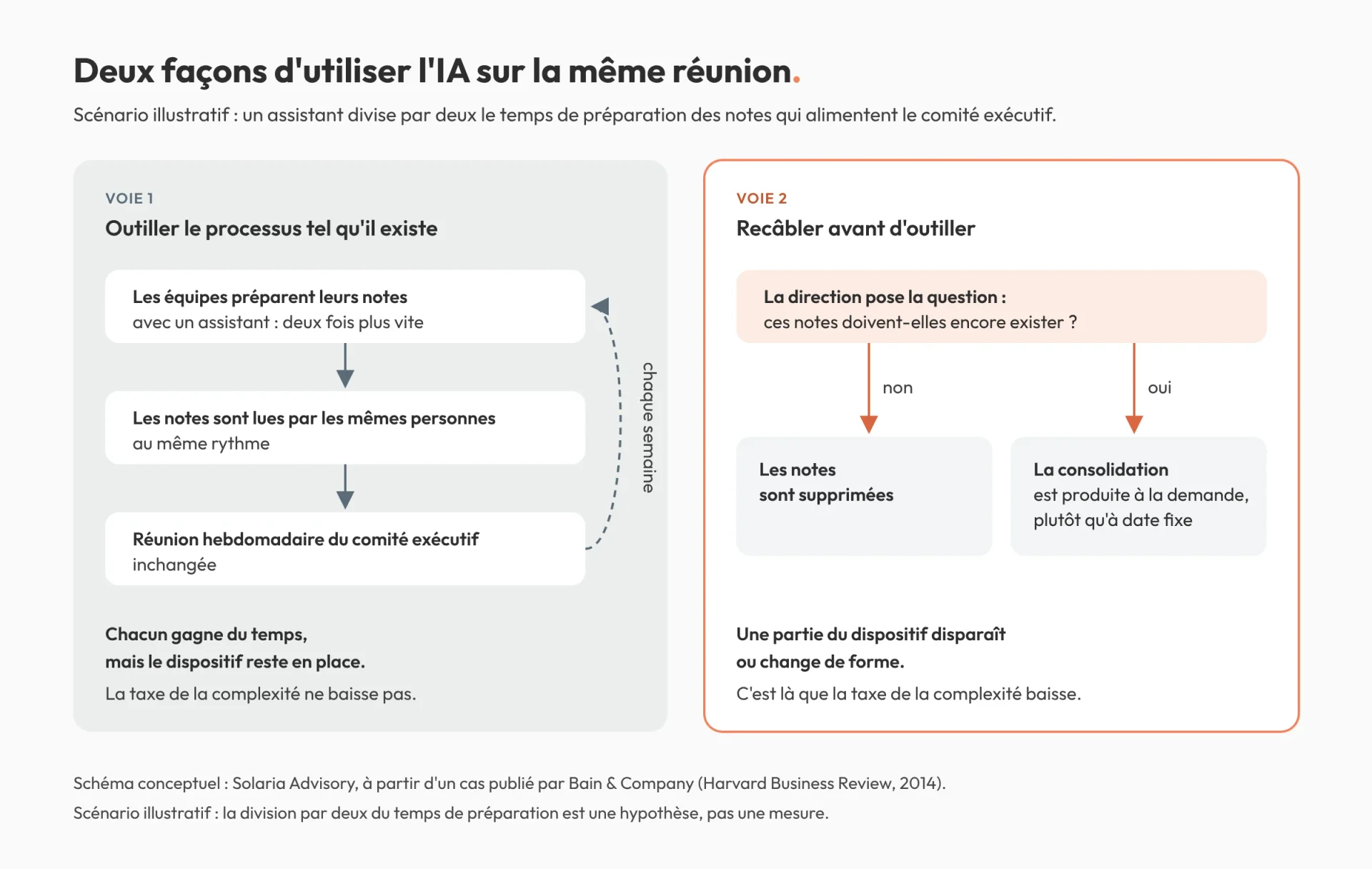
What needs to go, what can be automated, and what should your employees focus on? You need to have clarified this if you want to deploy AI appropriately and avoid many unpleasant surprises. Measure the time actually saved rather than the time people feel they have saved: in early 2025, experienced developers equipped with AI estimated that they had saved 20% of their time; when measured, they had taken 19% longer.
Finally, choose an area of responsibility (a customer, a product or a process) and put a small team equipped with AI in charge of it from end to end, exempt from the processes it does not need. After a few months, compare it with the rest of the organization.
The test
Your teams are saving time with AI. Where has it gone?
If no meeting, report or approval has disappeared, you have not saved that time. You have shifted it. What remains is to find out where.
And the day you have really saved that time, another question will arise. Those who paid the complexity tax were also those who understood how your company held together: by rebuilding the connections between departments every day, they kept a map of it in their heads. If small teams and their tools maintain these connections in their place, your organization could become more complex than any one person can picture, and continue to function. Who in your company will then understand how it works?
Sources
- MIT NANDA (Aditya Challapally et al.), The GenAI Divide: State of AI in Business 2025, July 2025 (preliminary findings: review of more than 300 public projects, interviews at 52 organizations, survey of 153 executives; “large companies”: revenues above $100 million).
- Frederick P. Brooks, The Mythical Man-Month, Addison-Wesley, 1975 (number of possible relationships in a group: n(n − 1)/2).
- BCG Henderson Institute, “In Conversation with Yves Morieux about Complexity”; Yves Morieux and Peter Tollman, Six Simple Rules, Harvard Business Review Press, 2014.
- Michael Mankins (Bain & Company), “This Weekly Meeting Took Up 300,000 Hours a Year”, Harvard Business Review, April 29, 2014; Bain & Company, “The 300,000-hour meeting”, May 8, 2014.
- Microsoft, “Will AI Fix Work?”, Work Trend Index, May 9, 2023 (Microsoft 365 activity, business users, 28 days through March 2023).
- Fabrizio Dell’Acqua et al., “The Cybernetic Teammate”, NBER, 2025; Organization Science, 2026.
- Kate Niederhoffer et al., “AI-Generated ‘Workslop’ Is Destroying Productivity”, Harvard Business Review, September 2025; survey details.
- Microsoft and LinkedIn, Work Trend Index 2024, May 2024.
- Tania Babina, Anastassia Fedyk, Alex X. He and James Hodson, “Firm Investments in Artificial Intelligence Technologies and Changes in Workforce Composition”, NBER Working Paper 31325, June 2023 (American companies, 2010-2018).
- Andy Jassy, message to Amazon employees, September 2024.
- Beth Galetti, message to Amazon employees, October 28, 2025; Andy Jassy’s remarks during the October 30, 2025 earnings presentation, reported by GeekWire.
- METR, “Measuring the Impact of Early-2025 AI on Experienced Open-Source Developer Productivity”, July 2025; February 24, 2026 update.

 Baptiste Lefort
 Alexandre Brethes